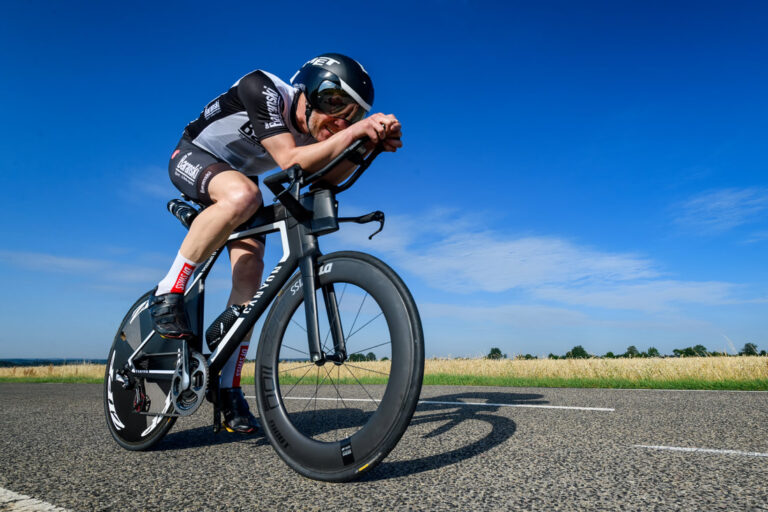
Ein enger Q-Faktor für bessere Aerodynamik. Really?
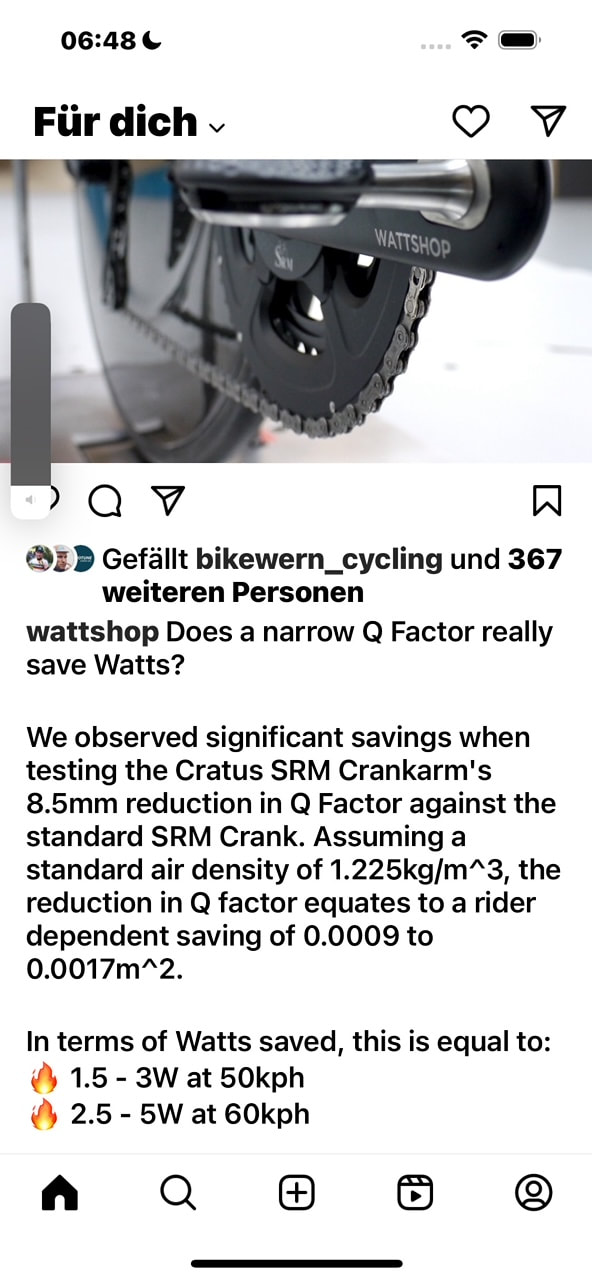
For english version see below! Heute geht es um den neuesten Trend bei Kurbeln für Triathlon- und Zeitfahrräder, genauer um den extra engen Q-Faktor für mehr Aerodynamik. Der macht nämlich den Abstand der Kurbelarme schmaler und somit aerodynamischer und laut dem Hersteller Wattshop aus UK spart man damit dann bei 50 km/h satte 1,5 bis […]
Datum
Lesezeit
Kategorie
Archiv
Heute geht es um den neuesten Trend bei Kurbeln für Triathlon- und Zeitfahrräder, genauer um den extra engen Q-Faktor für mehr Aerodynamik. Der macht nämlich den Abstand der Kurbelarme schmaler und somit aerodynamischer und laut dem Hersteller Wattshop aus UK spart man damit dann bei 50 km/h satte 1,5 bis 3 Watt. Als ganz grob und zirka.


Der Q-Faktor bezeichnet am Rad den Abstand von Kurbelaußenseite bis Kurbelaußenseite. Also da, wo die Pedalachse ins Metall oder Carbon geschraubt wird. Bei aktuellen Straßen- und Zeitfahrrädern mit 12-fach Schaltung und Scheibenbremsen sind das grob 144 Millimeter. Warum Schaltung und Bremse da was mit zu tun haben? Weil zwölf Ritzel, eine Bremsscheibe und Steckachse am Hinterbau einfach mehr Platz brauchen als ein Schnellspanner und früher mal sagen wir zehn Ritzel. Dazu kommt dann noch die Kettenlinie, die hinten mit vorne verbinden muss und dann darf ja die Kurbel auch nicht an Rahmen und Umwerferblech schubbern. Anders und breiter, unter anderem wegen mehr Reifenfreiheit sieht das bei allen Bikes für das Gelände aus, die sind dann vom Q-Faktor gern mal 174 Millimeter breit.
Wenn die Pedalachsen minimal im Material des Kurbelarmes verschwinden, verringert sich der Q-Faktor deshalb übrigens ganz leicht, die Pedale stehen dann etwas enger beieinander. Die Füße natürlich auch. Es gibt allerdings auch Pedale, die aus biomechanischen Gründen mit extra langen Achsen arbeiten. Shimano bietet vom SPD-SL-Modell etwa je Seite vier Millimeter mehr Länge an. Damit sind das dann 56 statt 52 Millimeter von Kurbel bis Pedalmitte nach außen.

Interessanter Tipp aus Japan: Wer regelmäßig zwischen MTB/Gravel- und Rennrad switched, der ist mit den längeren Achsen am Rennrad gut bedient, weil die dem grundsätzlich größeren Q-Faktor bei allen Bikes mit Stollenreifen näherkommen.
Ein anderer Pedalanbieter, der pauschal weiter „stellt“ ist Garmin mit den RS 200 Pedalen. Diese kommen je Seite mit einem 2-mm-Spacer, primär damit je nach Kurbelstärke die Rückseite der Pedalachse, in der die ganze Messtechnik steckt, im dümmsten Fall nicht mit der Kette kollidiert. Mir kommt das entgegen, denn ich fahre entweder die vier Millimeter mehr bei Shimano oder die RS 200 mit den Spacern.
Magnus Ditlev, über den und sein Material ich aktuell was für die triathlon geschrieben habe, die Ausgabe 221 erscheint am 22.5., lässt die Spacer bei seinen mit 142 Millimetern schon schmal bauenden Torno Carbonkurbeln von 3 T weg, weil es seiner Biomechanik zuträglich ist oder zumindest nicht schadet. Achtung, die Version von Wattshop für Road misst da sogar nur 138.
Und jetzt sind wir langsam da, wo ich schon die ganze Zeit mit euch hinwill: Der Q-Faktor ist nur die halbe Miete. Die Pedalachsen sowie die Pedalplattenposition sind genauso wichtig und ich hole extra noch ein bisschen weiter aus:
Weil es früher schonmal angesagt war, möglichst eng zu treten, gab es sogar einen Rahmen namens Walser mit extra schmalem Tretlager und Hinterbau (siehe oben), in den nur Spezialkurbeln und Hinterräder passten. Alles der verringerten Stirnfläche und vermeintlich besseren Aerodynamik zuliebe. Das Teil war so in, dass Ulle mit einem auf Giant umlackierten fuhr, Timo Bracht fuhr das als Cucuma gebrandet, die Gerolsteiner-Profis als Specialized und ein Lothar zog damit im Cube-Look vom Leder. Focus versuchte für sein Team Milram, das Walser-Prinzip auf serienmäßige Zeitfahrrahmen zu adaptieren, gab das aber schnell wieder auf. Witzigerweise fuhren auch ganz viele der damaligen Granaten einen null verstellbaren Aerolenker von Walser, samt einer Sitzposition, über die man heute nur noch lachen würde. Idee dahinter: Den Fahrtwind nach unten wegzudrücken, indem man wie ein Bremsfallschirm Arme und Oberkörper aufblähte und die komplett geraden (!) Extensions nach unten zeigten. Siehe auch das Gemälde mit mir auf meinem ersten Cervélo weiter oben. Ganz schlimm.
Speedplay bot damals für sein Pedal Zero extra kurze Pedalachsen aus Titan an, um die Füße extra eng zu stellen. Ich fuhr die damals auf allen Rädern und kam mir extrem getunt vor. Den Nachteil, dass gerade bei langen Zeitfahren und bei den 180 Kilometer-Staffeln in Roth die Außenkanten der Füße danach so wehtaten, dass man kaum auftreten konnte, nahm ich gern in Kauf, weil das war ja alles mehr aero. Kleiner Einschub: Speedplay gehört jetzt Wahoo und man kann da auch heute noch Achsen für die Zeros in Sonderlängen kaufen, allerdings nur noch länger, als die 53 Millimeter Standard.
Abhilfe kam für mich dann erstmalig per Bikefitting von Dr. Andy Pruitt, dem Mann hinter dem BG Fit System von Specialized. Er redete mir das mit eng stehenden Füßen aus, weil, jetzt kommt es: Ich so ja weder stehen noch gehen würde, sondern deutlich breiter. Ich ging also wieder zurück, und zwar sogar auf länger als Standardachsen. Eine andere, mit weniger Aufwand verbundene Option kann bei sowas auch sein, die Schuhplatten seitlich etwas zu verstellen, um mit dem Zentrum des Fußes über dem bei den Speedplay Zero lolliförmigen Pedalkörper zu sein, statt seitlich samt Schmerz beim langen Reinlatschen auf der Kante der Sohle. Für alle Zeitfahrer und Triathleten empfiehlt sich in diesem Zuge auch ein Umbau, den ich so auch seit damals fahre: Die Platten gingen ganz nach hinten, statt oldschool unter dem Ballen zu sein, was die gleichmäßige Kraftübertragung beim Zeitfahren begünstigt. Anders sieht das bitte weiterhin aus bei allem mit Kraftspitzen, etwa im Sprint oder an der Rampe im Gelände.

Wer mit Speedplay und/oder Wahoo Speedplay Pedalen Typ Zero unterwegs ist, ist mit passenden Edelstahlplatten gut bedient, die man zwischen Pedalplatte und Kunststoffadapter (bei Verwendung der Vierloch- auf Dreilochschuhe) fährt. Und/oder wer sauteure Carbonsohlen gleich mit Vierlochaufnahme für die Zero Pedale fährt, kann die Lebensdauer der teuren Treter immens damit verlängern. Ihr bekommt die Teile hier bei mir im derbaranski.shop.


Viel mehr solle man sich laut Oli eher auf sein Powerouput konzentrieren, statt hier auf eine vermeintlich besseren CDA-Wert zu schielen. Und mit breitem Becken gehe das nur mit entsprechend breiter Fußstellung als Summe von Q-Faktor, Pedalachslänge und Plattenposition. Natürlich immer in Kombination mit einer guten Sitzposition, idealerweise über ein Bikefitting feinjustiert.

Werbung Ende

Finde ich auch, deshalb heute mal dieser ellenlange Blog. Vor dem Gang zum Fitter reicht mal ein Blick im Spiegel: Wie breit steht ihr? Wie fallen eure Füße in Rückenlage? Wie fühlt sich die Pedalierbewegung an? Ein Spiegel kann dabei helfen. Und verabschiedet euch davon, dass da alles parallel und möglichst eng, weil dann vermeintlich aero sein muss. So richtig Bumms gibt es halt nur, wenn man sich dabei auch wohlfühlt.
Abschließend merke: Bei allem rund um Biomechanik und die Schnittstelle Mensch und Maschine hilft Pauschalisieren nicht wirklich weiter. Es sei denn, man möchte damit etwas verkaufen. Und wenn ich schon 50 km/h fahre, dann wüsste ich schon gern, ob ich 1,5 Watt oder das Doppelte sparen kann. Oder so. Danke fürs Dranbleiben.
And here we go with the Englisch version ladies and gentlemen!
Today we’re talking about the latest trend in cranksets for triathlon and time trial bikes, specifically the extra narrow Q-factor for improved aerodynamics. This basically means reducing the distance between the crank arms to make them more aerodynamic. According to the UK-based manufacturer Wattshop, this can save you around 1.5 to 3 watts when cruising at 50 km/h. Roughly speaking, that is.
But let me tell you, this idea isn’t exactly groundbreaking. When I recently came across it, I had to do a double-take. Over the years, I’ve developed a bit of a BS detector for these blanket claims, and it was buzzing loudly here. Because this idea isn’t as fresh and universally applicable as it’s made out to be; in fact, it can lead to problems for many cyclists. Trust me, I’ve experienced it firsthand.
So, what exactly is this Q-factor? It’s the distance between the outer edges of the crank arms on a bike. Think of it as the space where the pedal axle attaches to the metal or carbon. For modern road and time trial bikes with 12-speed drivetrains and disc brakes, that distance is roughly 144 millimeters. Why does the drivetrain and brakes matter? Because twelve gears, a disc brake, and a thru-axle at the rear require more space than, say, a quick release and fewer gears like we had in the past. Plus, there’s the chainline, which needs to connect the rear to the front without the crank rubbing against the frame or the front derailleur. Off-road bikes, with their wider Q-factors, can measure up to like 174 millimeters.
By slightly embedding the pedal axles into the crank arms, you reduce the Q-factor, meaning the pedals and consequently your feet are a bit closer together. However, there are pedals designed with biomechanics in mind that use longer axles. For instance, Shimano’s SPD-SL model offers an extra 4 millimeters of length on each side.
But wait, don’t confuse this with automatically increasing the Q-factor. Shimano calls it „Stance“ when you pedal with longer axles.
https://bike.shimano.com/en-US/information/news/shimano-dura-ace-and-ultegra-long-axle-pedals-enhancing-stance-w.html
Here’s an interesting tip from Japan: If you regularly switch between mountain biking, gravel, and road cycling, longer axles on your road bike might be beneficial. They bring the Q-factor closer to what you’re used to with off-road bikes with knobby tires.
Another pedal manufacturer, Garmin, offers the RS 200 pedals with a 2mm spacer on each side. This is primarily to prevent the rear of the pedal axle, where all the measuring technology is housed, from colliding with the chain depending on the crank thickness. I personally prefer either Shimano’s 4mm longer axles or the RS 200 with spacers.
Magnus Ditlev, whom I’ve recently covered for triathlon magazine (in issue 221, out on May 22nd), opts to remove the spacers from his Torno Carbon cranks from 3T, which already measure a slim 142 millimeters, because it’s biomechanically beneficial or at least not harmful. The Wattshop version for road bikes measures even narrower at 138 millimeters.
And now we’re getting to where I’ve been leading you all along: the Q-factor is only half the story. Pedal axles and pedal cleat position are equally crucial, and let me go a bit more in depth.
Back in the day, there was a craze for riding with narrow setups. There was even a frame called Walser after its builder, with an extra narrow bottom bracket and rear triangle, into which only special cranks and rear wheels fit. All in the name of reduced frontal area and supposedly better aerodynamics. It was so popular that Ulle rode one repainted as a Giant, Timo Bracht had one branded as Cucuma, the Gerolsteiner pros rode Specialized versions, and some Lothar rocked a Cube-themed one. Focus tried to adapt the Walser principle to mass-produced time trial frames for their Milram team, but quickly abandoned it. Interestingly, many of the top riders at the time also used zero-adjustment aerobars from Walser, along with a riding position that would make us laugh today. The idea was to push the wind downwards by inflating arms and upper body like a parachute, with completely straight extensions pointing, yes, downwards.
Speedplay used to offer extra short pedal axles for their Zero pedals made of titanium, to bring the feet even closer together. I used them on all my bikes back then and felt super tuned up. I was willing to put up with the downside that my feet’s outer edges would hurt after long time trials and 180-kilometer relays in Roth, to me, it was all about being more aero. Side note: Speedplay is now owned by Wahoo, and you can still buy longer axles for the Zeros, but only longer than the standard 53 millimeters.
Relief finally came through bike fitting by Dr. Andy Pruitt, the man behind Specialized’s BG Fit System. He convinced me to ditch the narrow stance because, here’s the kicker, I wouldn’t be able to stand or walk properly, let alone cycle, with such a narrow stance. So, I switched to even longer than standard axles. Another, less involved option for this is adjusting the cleat plates sideways slightly, to align the center of the foot over the lollipop-shaped pedal body of the Speedplay Zero, instead of causing lateral pain when pushing for a long time. For all time trialists and triathletes, a modification is recommended, which I’ve been using since then: moving the cleats all the way back instead of the old-school under the ball of the foot position, which promotes even power transfer during time trials. However, this setup is different for efforts requiring spikes in power, like sprints, MTB or hill climbs.
Because this fits so nicely and serves as a great segue, here’s part 1 of today’s advertisements: If you’re riding with Speedplay and/or Wahoo Speedplay Pedals Type Zero, you’re well served with matching stainless steel plates that fit between the pedal plate and plastic adapter (when using three-hole shoes with a four-hole adapter). And/or, if you’re riding with expensive carbon soles with four-hole mounts for the Zero pedals, you can immensely extend the lifespan of your expensive shoes with them. You can get these parts from me at derbaranski.shop.
The pedal movement and the watts you generate through the bike system only really become a shoe as we say in German (funny here, eh?) when you have the right insoles, regardless of which pedal system you’re using. For a few years now, I’ve been a big fan of the BLK version from Solestar in Cologne, which you can get from me risk-free. If you’re not satisfied within six weeks, just send them back to me and get your money back.
By the way, the mastermind behind the Solestar insoles is Oli Elsenbach, whom I’ve previously blogged about. When Oli gets into it, things quickly get nerdy and hands-on. He’s conducted numerous tests on leg axles and narrow cranks, including with national track riders on their FES bikes and with his own FES power meter, which measures left/right separately. According to Oli, while those bikes (because they lack drivetrains and brakes) can be built extremely narrow, only three out of ten test subjects actually benefit from it. When large and wide riders are set up too narrowly, it usually backfires, much like it did for me as a hobbyist cyclist ten years ago on a road bike. According to Oli, the plumb line of the leg axis should always fall vertically through the femoral head at the transition from pelvis to thigh, envisioning it as if you’re pushing straight down like a cylinder. And of course, this heavily depends on your build and how your legs and feet move when you’re not on the bike. While you can see this from the front, you can also measure it in terms of torque. Interestingly, in our conversation, Oli also talks about how power distribution doesn’t necessarily have to be 50/50, as some power meter providers now claim, and as more athletes now consider it the ideal distribution for their cycling. Rather, one should focus on power output instead of aiming for a supposedly better CDA value. And with a wide pelvis, this can only be achieved with a wider foot stance, taking into account the sum of Q-factor, pedal axle length, and cleat position. Of course, always in combination with a good riding position, preferably through bike fitting.
Before we dive into the debate on narrow or not so narrow from one of the authorities in the field of watt measurement, crank standards, and paid cycling, here’s today’s second advertisement block.
And that wraps up today’s long blog. Before heading to a fitter, take a look in the mirror: How wide do you stand? How do your feet fall when lying down? How does your pedalling motion feel? A mirror can help with that. And let go of the idea that everything needs to be parallel and as narrow as possible just for the sake of being aero. True performance comes when you feel comfortable.
In conclusion, remember: When it comes to biomechanics and the interface between human and machine, generalizations don’t really help. Unless, of course, you’re trying to sell something. And if I’m already riding at 50 km/h I’d really like to know if I can save 1.5 watts or even double that. Or something like that. Thanks for sticking around!